
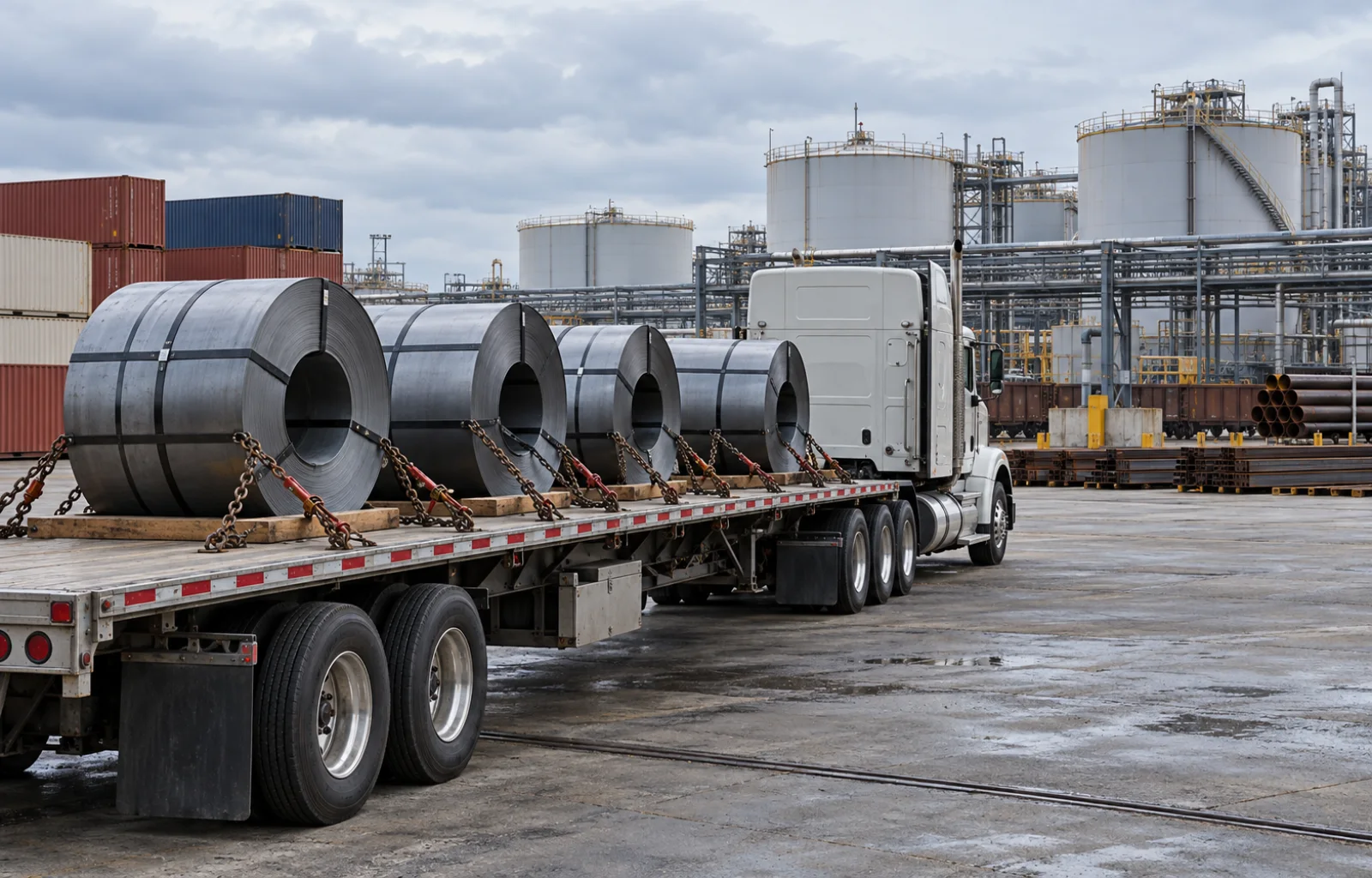
The August import increase was strongest in the industrial side of the freight economy. The Census Bureau’s September 30 advance report put seasonally adjusted goods imports at $336.051 billion, up 5.5% from July. Industrial supplies rose 16.6% to $62.429 billion, while capital goods increased 4.0% to $145.842 billion. Consumer-goods imports moved in the opposite direction, declining 1.6% to $57.035 billion. A higher national import total therefore carries a different message for industrial haulers and merchandise distribution fleets.
Using the report’s revised July figures, industrial supplies added $8.901 billion and capital goods added $5.578 billion. Together they accounted for about 83% of the $17.421 billion monthly import increase, a FreightNews calculation from Table 1. Consumer goods subtracted $929 million. Foods, feeds and beverages increased 5.5%, automotive vehicles and related products rose 0.9%, and other goods increased 18.8%. These are broad end-use categories rather than equipment assignments: capital goods can include cargo whose value is large relative to its weight or cube.
The industrial-supplies category includes petroleum and petroleum products. That boundary matters because an increase can reflect fuel or commodity prices, physical quantities, or a changing mix. The advance table is adjusted for seasonal patterns but not price changes. It does not establish a 16.6% increase in tons, tank-truck loads, flatbed shipments or any other physical transport measure. Nor does it identify how much of the import value arrived by vessel, rail, truck or air.
The adjusted and unadjusted readings also answer different questions. Unadjusted goods imports increased only 0.9% from July, compared with the adjusted 5.5% gain. The former describes reported current-dollar arrivals without removal of recurring seasonal effects; the latter is the agency’s comparison after that adjustment. Carriers should retain both labels rather than switching between them to make an August freight surge appear larger or smaller.
 See how the work connects
Exports increased 1.9% to $203.415 billion, but their mix split too. Industrial-supplies exports rose 8.3% and capital goods rose 2.0%, while consumer goods fell 10.5%, automotive vehicles and related products fell 6.9%, and foods, feeds and beverages fell 5.6%. The goods deficit widened to $132.636 billion. That deficit is a difference between export and import values; it is not an empty-mile estimate or a measure of the backhaul available at a specific gateway.
The release contains another reason to keep the data vintage intact. Census now puts July retail inventories at a revised $879.001 billion and August at $881.623 billion, a 0.3% monthly increase. Its general notes say retail estimates in this release reflect revised historical data. Comparing August with an older published July level would mix vintages and overstate the change. Inventories excluding motor vehicles and parts rose just 0.1%, while dealer inventories rose 0.8%; neither figure reports warehouse turns or a count of new inbound loads.
FreightNews infers that the practical question is which industrial customers have released actual import-linked work, rather than whether all peak-season fleets should add capacity. A bulk carrier needs the product, terminal and tank specification; a machinery hauler needs dimensions, handling requirements and a delivery date. A merchandise fleet needs customer order and container-release evidence before treating the aggregate import rise as its own demand signal. Those are planning applications of the category split, not Census forecasts.
The advance goods figures reflect nearly complete coverage and remain subject to revision in the full trade report. For a bid or staffing decision, save this September 30 table and match its end-use signal to booked customs releases, commodity units, handling appointments, available equipment and return work. The useful national finding is concentrated growth in industrial and capital imports alongside softer consumer-goods imports; the profitable lane still has to be documented by the customer.