

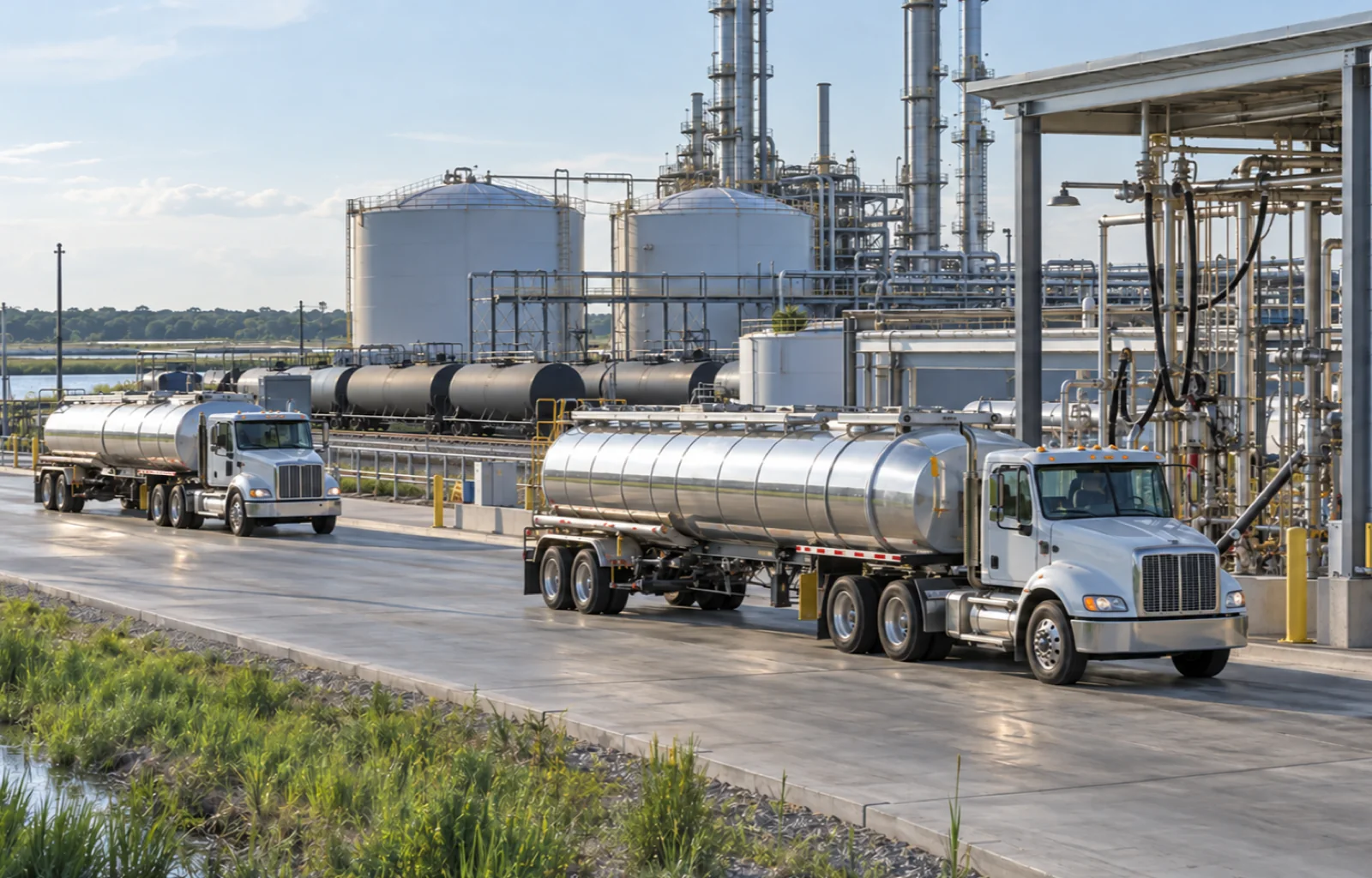
U.S. renewable diesel and other biofuels plants entered 2026 with more nameplate capacity but no increase in plant count, according to an Energy Information Administration report released Thursday. EIA lists 19 operating plants capable of producing a combined 324,000 barrels per day as of January 1, up from 308,000 barrels per day at 19 plants one year earlier. The 5.2% increase is FreightNews arithmetic from EIA's rounded national totals.
The added capability was not spread evenly across the country. Gulf Coast capacity rose to 160,000 barrels per day from 139,000, while West Coast capacity edged to 119,000 from 117,000. Rocky Mountain capacity held at 26,000, and Midwest capacity fell to 19,000 from 26,000. The Gulf and West Coast regions therefore held about 86% of the new national total, a FreightNews calculation from the rounded regional figures; EIA reported no plant in the East Coast district.
The label around that 324,000-barrel total matters. EIA's category includes renewable diesel, renewable heating oil, renewable jet fuel, renewable naphtha and gasoline, other biofuels and biointermediates. It also includes refineries that co-process renewable feedstock with petroleum. The annual number cannot be read as 324,000 barrels per day of finished on-road renewable diesel available to fleets.

Capacity is also not output. EIA defines it as the volume a plant is capable of producing in one day, while the report is a January 1 snapshot of operating facilities. It does not state how hard each plant ran, how much inventory was saleable, which products occupied flexible equipment, what volume entered domestic distribution, which terminals received it or what a fleet would pay. Those are separate production, trade, logistics and price questions.
Later EIA evidence shows why that separation is operationally important. The agency reported in May that the United States exported about 20% of combined renewable-diesel and other-biofuels production during the second half of 2025. Exports then averaged less than 35,000 barrels per day in January and February 2026, down from nearly 50,000 in the prior half-year, while EIA said lower production and idled capacity contributed to the change. Nameplate capability can remain in the table while actual output and destination move.
The rest of Thursday's report does not describe one uniformly expanding biofuels system. Biodiesel capacity slipped to 128,000 barrels per day at 45 plants from 130,000 at 48 plants a year earlier. Fuel-ethanol capacity eased to 1.202 million barrels per day at 189 plants from 1.205 million at 191 plants. Those categories have different products and markets, so adding every barrel of biofuels capacity together would not produce a defensible on-road diesel-supply estimate.
FreightNews infers that the regional concentration makes the route from plant to rack as important as the national headline. A fleet in a market far from Gulf or West Coast production may depend on pipeline eligibility, rail or truck movement, terminal storage, blending and a supplier's contracted allocation. A larger U.S. nameplate total does not by itself establish that the same product, specification and price are available at every fueling location.
This report answers a different question from FreightNews' September 15 diesel-price outlook and August 22 distillate-inventory analysis. Those stories tracked expected retail cost and the weekly petroleum supply cushion. The new evidence is an annual plant-capability map covering a broader product basket. It can inform long-range sourcing and network discussions, but it cannot replace current production, stock, terminal or delivered-price data.
Fuel and procurement teams can use the release as a capacity screen rather than a purchase instruction. For each lane or terminal, confirm the actual product offered, producing or supplying facility, expected monthly volume, delivery mode, rack or delivered price, taxes and credits, contract allocation, outage treatment and substitute-fuel plan. Then compare invoices and lift records with the supplier's commitment. The defensible conclusion is that U.S. capability expanded modestly and remained highly concentrated—not that every diesel fleet gained an automatic new fuel cushion.