

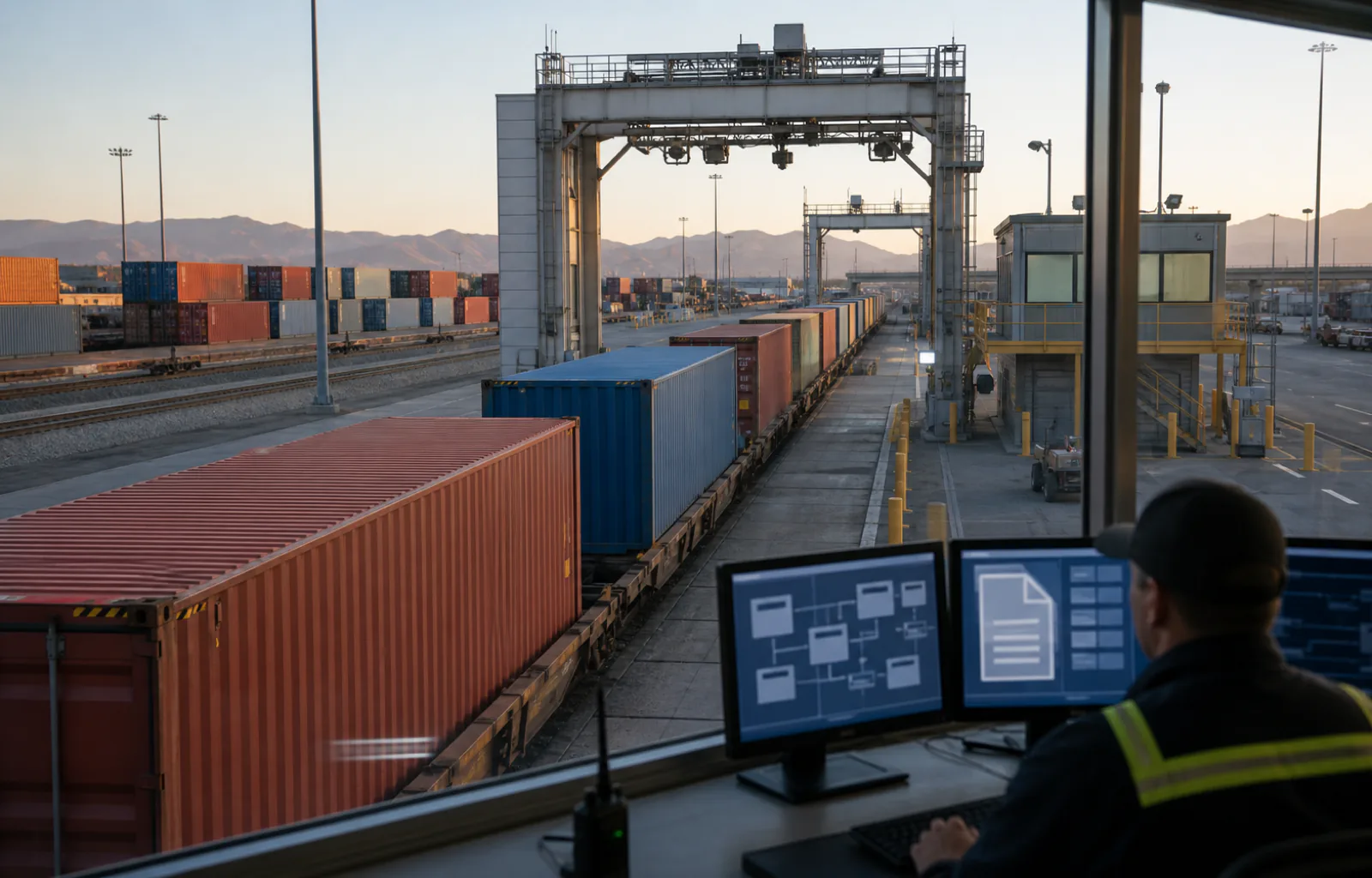
Rail freight leaving the United States for Canada or Mexico is moving toward a mandatory electronic manifest handoff. Customs and Border Protection's final rule requires advance export data in the Automated Commercial Environment for all rail cargo, replacing the paper-dependent gap that the agency said limited its pre-departure risk review.
The rule is effective October 26, 2026, but CBP will not begin enforcement until October 26, 2027. That one-year separation is an implementation runway, not an exemption from planning. Rail carriers, shippers, forwarders and brokers now have a fixed date against which to map data ownership, transmission capability and bond coverage.

The first filing is due as early as practicable and no later than 24 hours before the train's scheduled departure from the U.S. port of export. CBP clarified that the clock is tied to the designated border port, not an inland rail yard. The remaining transportation, cargo and empty-container information generally must arrive at least two hours before that departure.
Responsibility does not sit with one participant for every field. The outbound rail carrier must transmit transportation and empty-container data. A U.S. or foreign principal party in interest, its agent, a customs broker, Automated Broker Interface filer, non-vessel-operating common carrier, freight forwarder or another party with direct knowledge may transmit initial or cargo data. If no eligible party elects to do so, the outbound carrier becomes the backstop.
The final text also ties compliance to an appropriate customs bond. CBP said an active international carrier bond, basic custodial bond or basic importation-and-entry bond can secure a filing in that order when available. A bond without the condition covering advance export information will be deemed insufficient when enforcement begins.

Data quality can stop a movement, not merely create a later correction. After its risk assessment, CBP may issue a referral requiring more information or another action before cargo departs. A Do-Not-Load or Hold instruction goes to the carrier and other transmitter, and a Do-Not-Load instruction bars the rail carrier from moving the cargo or railcar until the issue is resolved.
FreightNews infers that motor carriers handling the first or last highway leg should add the manifest cutoff to appointment and document handoffs even though the rule governs rail export transmission. A dray move that reaches the terminal without the party, identifier or cargo details expected upstream can consume the buffer before the 24-hour or two-hour deadline. That is an operating implication of the rule's timing, not a CBP requirement imposed directly on every trucker.
A useful implementation file should name the transmitter for each data group, the source system for every mandatory or conditional field, the correction path, the bond owner and the person who can respond to a referral. Testing that chain against a real Canada and Mexico movement before October 2027 is more valuable than treating the enforcement delay as unused calendar time.