
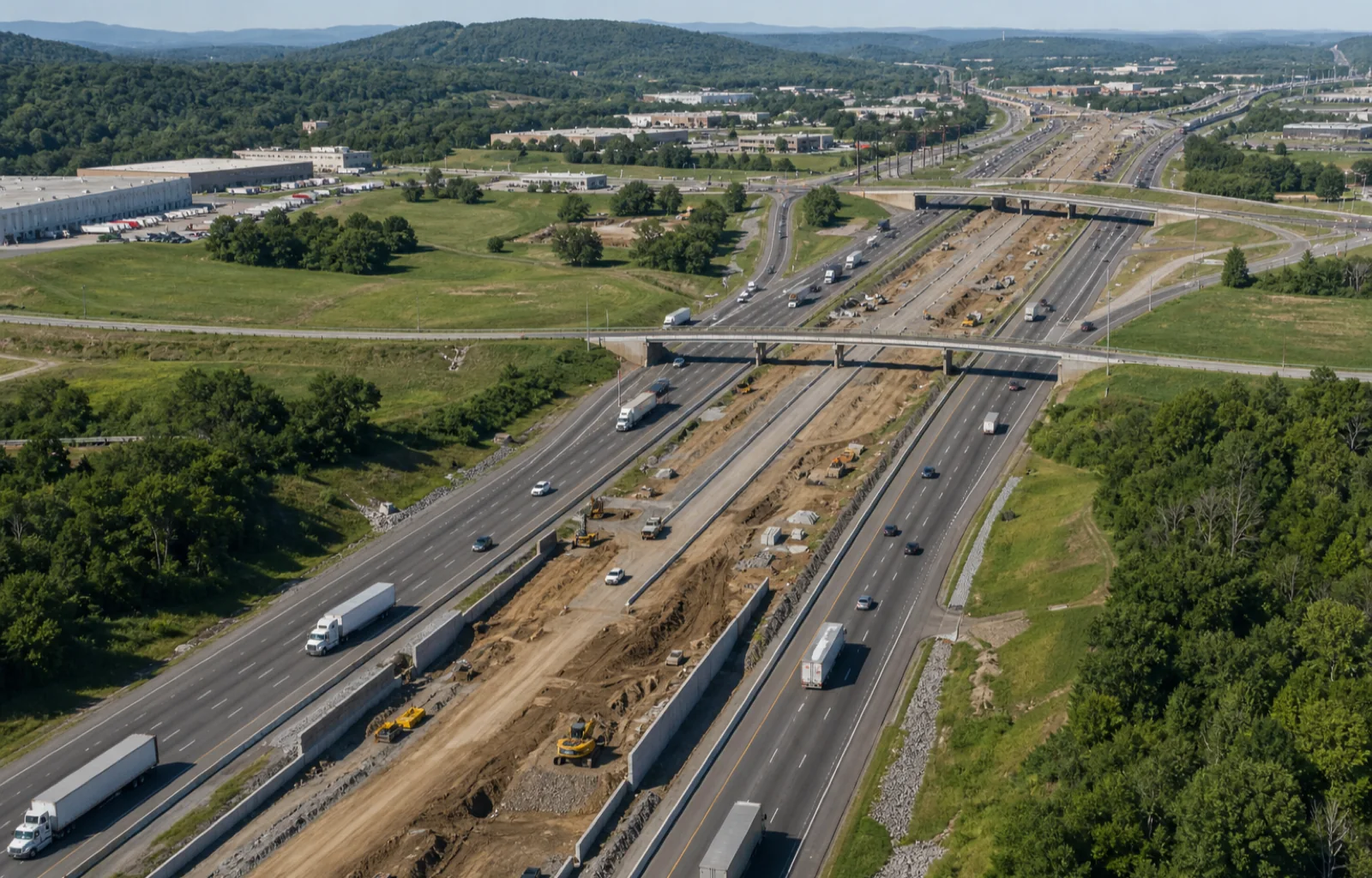
The Federal Highway Administration published final agency action on August 17 for Tennessee's I-24 Southeast Choice Lanes project. The environmental decision covers about 26 miles from I-40 in Nashville to I-840 near Murfreesboro. It clears the selected alternative under the cited federal reviews; it is not a notice that construction has begun.
The approved concept adds two price-managed lanes in each direction. Tennessee's project notice also describes reconstructing or realigning about 17 miles of existing general-purpose or high-occupancy-vehicle lanes affected by the work, while retaining the current number of those lanes. The plan includes interchange and access changes plus resurfacing of general-purpose lanes within the project limits.
The structure count shows the scale behind the lane headline. TDOT lists 37 bridge replacements, three bridge widenings, 55 new bridges, about 77 retaining walls totaling 18.9 miles, roughly 30 noise barriers and about 43 acres of right-of-way acquisition. Those are planning-scope quantities, not a daily closure calendar or a promise that every element will proceed at once.
Tennessee intends to deliver the managed lanes as a public-private partnership in which a private entity would design, build, finance, operate and maintain them. The Federal Register notice says the price-managed lanes are intended to generate revenue and support accelerated delivery. It does not set toll rates, opening dates, truck pricing, construction phases or lane-closure schedules.
 See how the work connects
The legal clock is more specific than the operating clock. FHWA says a claim seeking judicial review of the final federal actions generally must be filed by January 14, 2027, unless a shorter legal period applies. That deadline narrows when certain challenges can be brought; it does not tell a dispatcher when equipment should leave I-24.

The operating inference is that fleets should treat the decision as a corridor-planning trigger, not a route-change trigger. Commercial vehicles are included in the project's stated user base, but carriers still need the eventual access rules, pricing, transponder or account process, construction sequencing, restrictions and travel-time evidence before deciding whether the new lanes change a lane plan.
For now, network teams should map which customers, terminals and driver schedules depend on the I-24/I-40 and I-24/I-840 limits, assign an owner to procurement and construction updates, and preserve baseline travel-time and dwell data. When work-zone stages arrive, that evidence will support departure windows, alternate routes and customer notices. Environmental clearance makes the project more concrete; it does not make today's dispatch plan obsolete.