
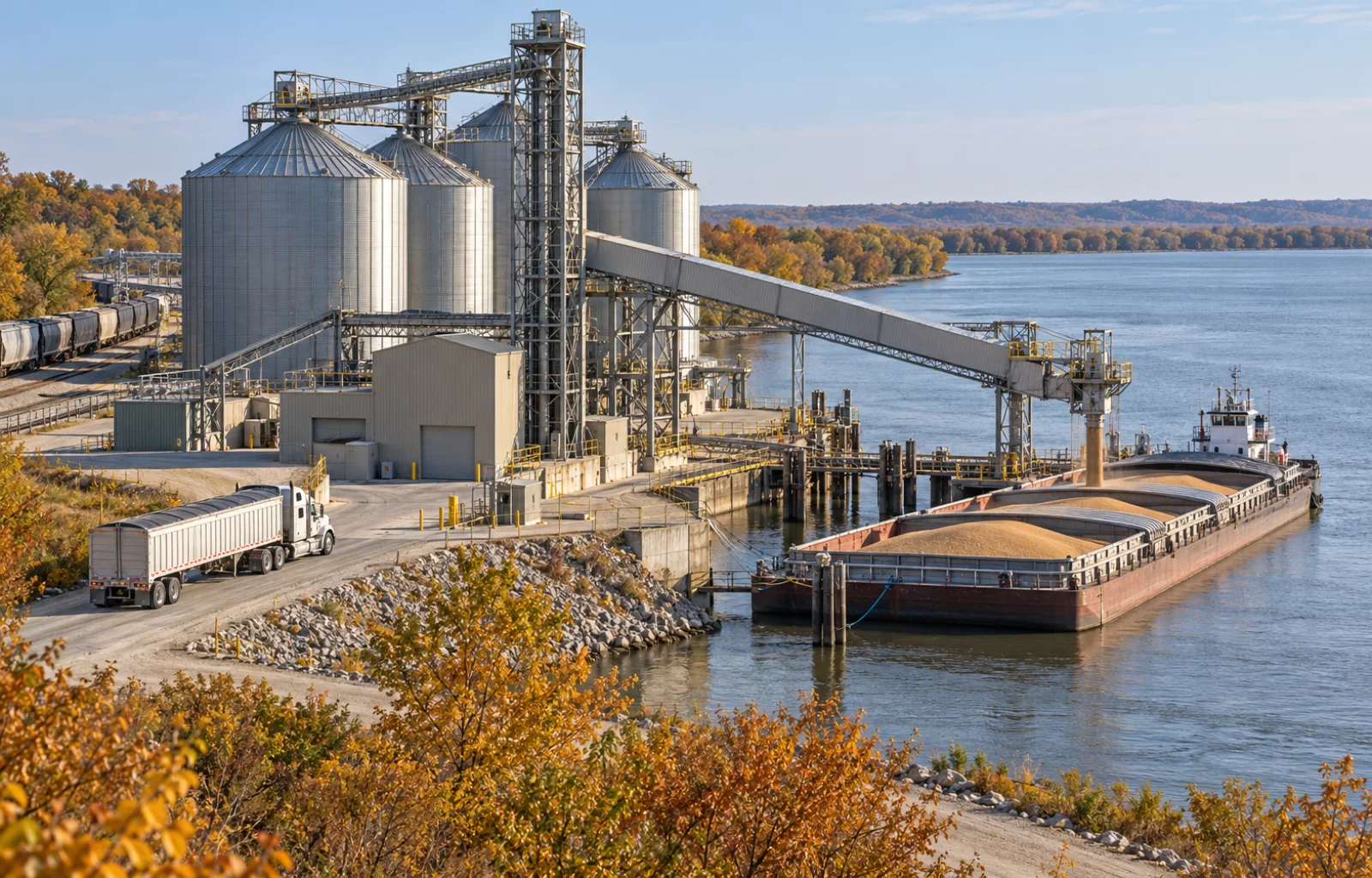
A barge disruption can create a demand for alternative transportation without creating an executable truck movement. For grain carriers reviewing contingency business, the useful question is how the displaced commodity can reach an accepting destination at a workable cost. USDA’s 2026 inland-waterways research offers a way to examine that question: look at what a diversion model assumes about the replacement network before using its results in a commercial decision. This is an analysis of published research, not a report of a new river closure.
The study broadens USDA’s earlier waterways work beyond corn and soybeans to include wheat, rice and sorghum, and expands its state coverage. That wider geography matters to trucking readers: inland waterways connect agricultural production with export outlets across multiple regions. A carrier can participate in a river-linked supply chain through an inland terminal even when its own trucks never travel beside the river.
Two modeled diversions illustrate the limits. The executive summary examines 22,500 tons of soybeans moving from Scott County, Iowa, to New Orleans and 6,000 tons of wheat moving from Whitman County, Washington, to Portland, Oregon. In each case, it compares a water route with a rail alternative. These are specified analytical movements, not freight offers, current closures or forecasts of loads becoming available to truckers.
The modeled transport cost rises from $852,258 by water to $911,411 by rail on the Iowa route, and from $95,354 to $115,290 on the Washington route. FreightNews calculates increases of about 6.9% and 20.9%, respectively, using water cost as the base. These are scenario results, not current quotes. The Iowa comparison explicitly assumes that rail capacity remains available and rail rates stay constant for the diverted movement. USDA warns that a larger diversion could constrain rail capacity and increase rates. A model that can place one shipment on an alternative route therefore does not establish that the same route can absorb every shipment affected by an extended outage. Its cost result depends on the scale and assumptions of the exercise.
 See the connected carrier TMS
FreightNews’s commercial inference is to split a contingency inquiry into three decisions. First, establish the actual shipment: commodity, quantity, release dates and receiving location. Second, confirm the intermediate transfer: which facility can unload a truck, store the grain if needed and send it onward. Third, obtain a usable transportation commitment for the next leg and test the quoted cost against the customer’s alternative. A theoretical route through a terminal is incomplete when that terminal has no receiving slot or onward capacity.
For a fleet, a diverted movement may mean a different first leg rather than a complete replacement of a river journey. Price the specific truck assignment offered. Include the changed round-trip mileage, expected unloading time, equipment suitability and any return-load assumption. Ask who bears a delay if the onward movement fails. Those are proposed bid-review questions, not cost estimates supplied by the USDA model.
The same distinction should govern how carriers read infrastructure plans. The summary describes a federal waterways capital-investment strategy as a planning framework rather than a funding commitment. A proposed improvement is useful context for long-term market development; it does not establish that a terminal or route will be ready on a customer’s requested shipping date. Keep the research scenario, the physical receiving plan and the priced truck commitment separate before accepting replacement freight.