

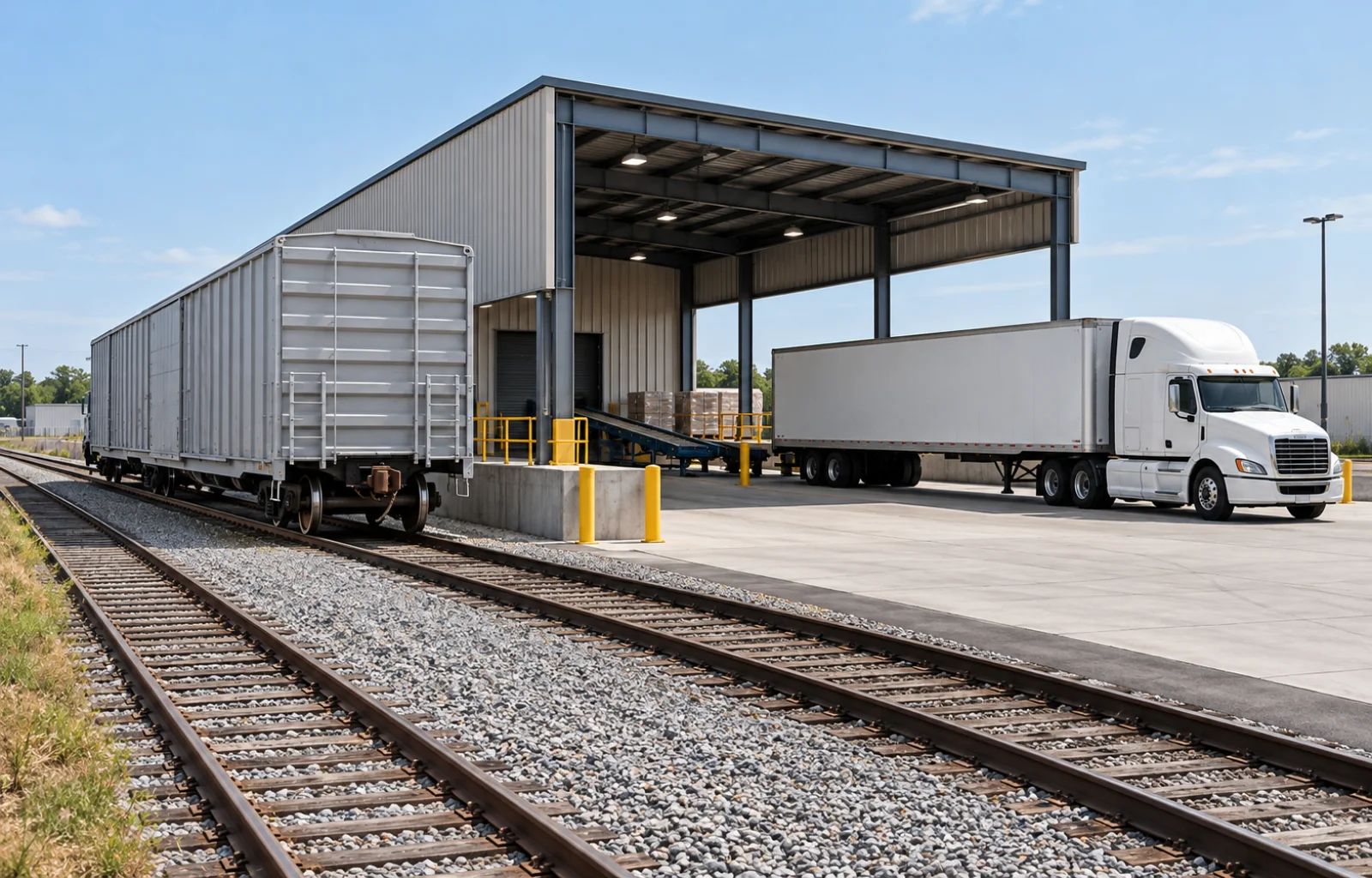
A truck carrier serving a rail transload facility needs to know when freight can actually reach its trailer. A railroad’s delivery-reliability percentage answers a different question. Under the Surface Transportation Board’s current service-reporting framework, a loaded railcar can reach the reporting definition of delivery through constructive placement at a convenient local yard. That milestone can precede placement at the receiving facility and transfer into a truck. This resource examines the gap and its implications for quoting truck time.
The distinction is explicit in the Board’s May 8 final rule establishing Part 1251 reporting, whose initial reporting date was July 8. For this data collection, delivery includes actual placement at the designated destination or constructive placement at a nearby local railroad yard. For an interline movement, the designated destination can instead be the interchange where the shipment is offered to the next carrier. A reported delivery therefore needs to be matched to its defined endpoint before it enters a truck-capacity plan.
The original-estimated-time-of-arrival measure, or OETA, counts qualifying manifest shipments delivered no later than 24 hours after the original estimate. STB’s current data page says its scope is manifest traffic moving only within the United States, excluding cars placed in bad-order status during shipment. It is neither an intermodal container-availability score nor a promise that a particular car’s contents will be ready for a highway appointment. The percentage also supplies no truck waiting-time distribution.
Local placement has its own measure. Industry spot and pull, or ISP, tracks scheduled railcar placements and pickups completed during planned service windows, following requests made before the applicable cutoff. STB publishes system and operating-division results. The measure excludes unit trains, intermodal traffic and cars put in bad-order status after reaching the serving yard. For a manifest-car transload operation, it can help frame questions about local service; a container drayage operator should not substitute it for ramp-specific availability information.
The carrier methodology adds essential detail. Union Pacific’s August 23 methodology says it counts a manifest car as successfully spotted or pulled when service occurs early, on time or within eight hours after the scheduled time. A missed window is recorded as a miss and the car is rescheduled and measured again. Specified customer-caused changes cancel the original window and move measurement to the replacement schedule. These are that railroad’s reporting rules, not a universal eight-hour truck appointment tolerance.
Terminal dwell is a third clock. Union Pacific’s separately published dwell methodology measures hours a railcar resides at a terminal, from events such as train arrival or customer release through events including departure, placement or interchange. It excludes cars passing through on the same train and certain other car statuses. Consequently, adding a public average dwell figure to an OETA does not calculate a dependable truck loading time: the measures have different populations and event boundaries.
FreightNews’s cost-planning recommendation is to map the handoff into distinct timestamps: the reporting delivery event, placement on the facility’s receiving track, completion of freight transfer or preparation, and the truck’s confirmed loading window. Ask the transload operator which event triggers truck dispatch and who sends that confirmation. If the commercial proposal requires equipment to wait earlier, identify the reserved hours, cancellation terms and payment arrangement in the quote. The public scores do not price that commitment.
For example, a car constructively placed at a local yard may satisfy the reporting endpoint while still awaiting a requested spot at the customer’s track. That is an illustration of the definitions, not a report of a delayed shipment. The next useful evidence is the car-specific placement status and the facility’s loading readiness. Keeping those milestones separate lets a carrier compare the full rail-and-truck service offer with a direct highway option without assuming that a successful rail delivery score has already released the next truck turn.