
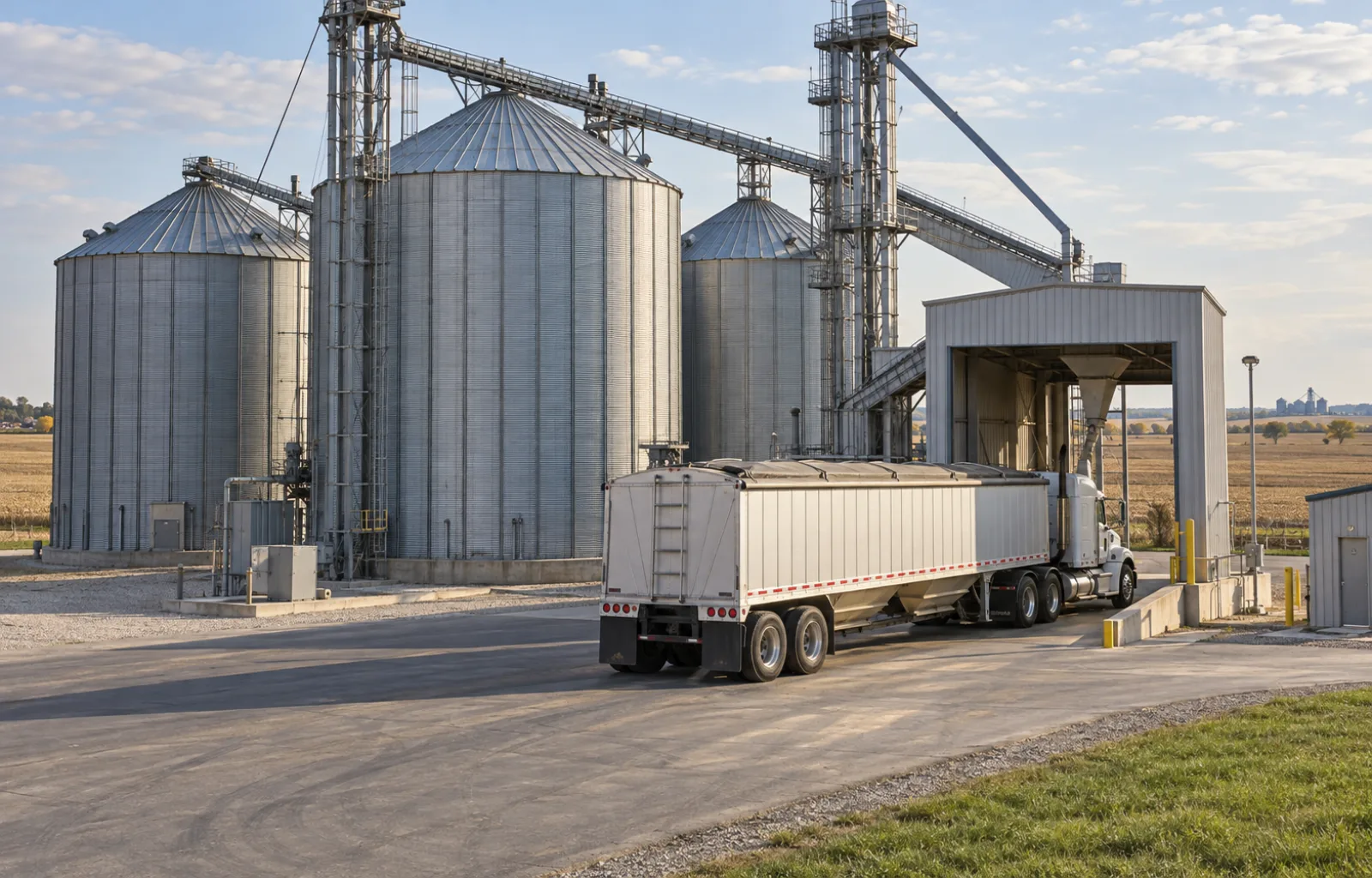

A national grain-storage surplus does not tell a harvest fleet where the next load can be unloaded. USDA’s October 8 Grain Transportation Report estimates a 381-million-bushel U.S. storage cushion for this fall, yet projects deficits in 18 states. That geographic mismatch creates a nationally useful dispatch question: which receiving facilities have confirmed room and an onward movement plan?
The agency compares beginning grain stocks and projected new production with storage capacity. Its national cushion improves on last year but is the second smallest since 2018. Six projected state deficits exceed 100 million bushels: Iowa, Nebraska, Missouri, Illinois, South Dakota and Indiana. Iowa has the largest, at 313 million bushels; Nebraska’s 177-million-bushel deficit is smaller than its 424-million-bushel gap last year.
This is a planning estimate with several vintages, not a live inventory of empty bins. USDA uses September 1 stocks, September crop projections and storage capacity measured December 1, 2025. The report notes that the October crop-production update is scheduled for October 9. Preserve that cutoff when using the assessment today; a later crop estimate can change the projected balance.
FreightNews infers that spare capacity in one state cannot automatically relieve a constrained receiving point elsewhere. A truck needs a destination that accepts the commodity and quality, has an available delivery window and can be reached economically. A state surplus says nothing by itself about the storage contract, queue or receiving status at a specific elevator.
For a carrier serving several grain origins, a useful worksheet has one row per confirmed receiving option. Record the commodity, remaining booked deliveries, receiving hours, appointment requirements and the person who can confirm acceptance. Add the authorized alternative destination and the extra round-trip miles. Treat unavailable answers as open questions, rather than assuming that the national cushion fills them.
The onward plan deserves the same attention. Ask the shipper whether grain is intended to remain in storage or move into processing, rail or barge service, and whether that next handoff is actually booked. This proposed carrier workflow is not a USDA forecast. It helps expose a schedule dependency before equipment reaches a destination whose outbound movements determine how quickly it can receive more grain.
A projected storage deficit also is not a truckload total or proof that harvest traffic must leave a state immediately. Grain can be consumed or shipped as the season proceeds. Fleets should budget against offered loads, confirmed receiving capacity and realistic turns per day, while keeping the USDA geographic signal as context. Better national availability can coexist with a difficult local unload—and with materially different harvest plans across regions.