
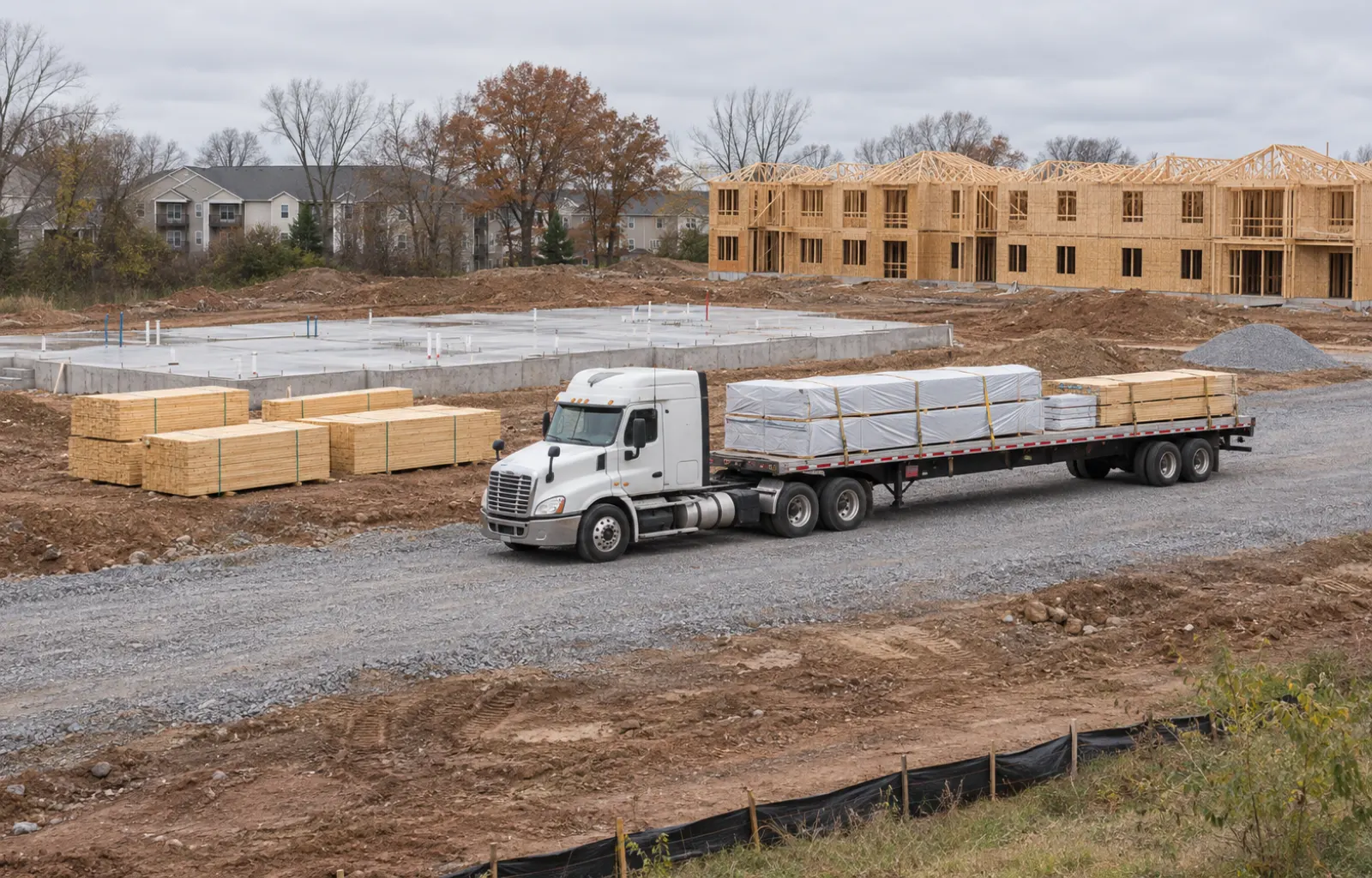

U.S. privately owned housing starts reached an estimated annual rate of 1.309 million units in October, up 9.9% from revised September figures, the Census Bureau and Department of Housing and Urban Development reported Wednesday. Most of the estimated gain came from buildings with at least five units. For building-material haulers, the next question is how much of that work has firm delivery dates.
Starts in buildings with five or more units rose from an annualized 345,000 to 433,000. FreightNews calculates that the difference of 88,000 was roughly three-quarters of the 118,000 increase in the overall annual rate. Single-family starts rose from 831,000 to 864,000. These figures are seasonally adjusted annual rates. The reported 90% confidence interval for the overall monthly change includes zero, so the gain remains an estimate with considerable uncertainty.
The survey counts every apartment in a building as started once excavation for the foundation or footings begins. One building can add dozens of units to the estimate in a single month. Its material shipments may run across several months and through multiple suppliers. A carrier that handles framing packages could see its first delivery well after the excavation that put all those units into the October data.
The October estimate also uses a lower September baseline. The September release had put starts at an annual rate of 1.221 million before the October report revised that figure to 1.191 million. A demand worksheet should replace the September figure with the revised one before comparing months and record the release date so a later revision can be traced.
Authorizations offer a separate view of the pipeline. Total permits fell 7.4% to a 1.295 million annual rate, with single-family permits down 8.7% to 772,000. A carrier with mostly single-family customers can check whether builders are releasing fewer jobs from their upcoming schedule. A carrier with multifamily work can check which projects have moved from excavation to a phase that needs the products it actually hauls.
Consider a hypothetical distributor with framing packages for a 60-unit building on its open-order report. If the site superintendent has confirmed space and a receiving window for two trailers next week, those two trailers belong in the capacity plan. Subsequent packages can sit on a watch list with the next confirmation date. Even when all 60 units entered the housing count together, later deliveries still depend on the construction schedule and room to unload.
Before adding dedicated equipment or quoting a repeat lane, ask the shipper for a project identifier, the next material release date and the receiver’s confirmed unloading windows. Match those details against actual tenders by week and keep estimated work visible in a separate column. The national release can help prioritize which customers to call. The booked work and site schedule should determine how many trucks to commit.